Hyderabad is one of India’s leading destinations for startups, technology companies, manufacturers, professional firms, traders and service-based businesses. Its growing infrastructure, skilled workforce and strong commercial ecosystem encourage many entrepreneurs to start and expand their businesses in the city.
However, launching a business requires more than selecting a name, renting an office and finding customers. Entrepreneurs must choose a suitable legal structure, complete the necessary registrations, maintain proper accounts and comply with applicable tax regulations.
Understanding business registration and tax compliance in Hyderabad helps entrepreneurs avoid penalties, improve credibility and build a strong foundation for sustainable growth. Professional guidance from a Chartered Accountant can simplify the registration process and ensure that the business meets its ongoing financial and regulatory responsibilities.
What Is Business Registration?
Business registration is the process of legally establishing a business under an appropriate structure. The procedure depends on the number of owners, nature of operations, liability exposure, investment requirements and long-term growth plans.
A business may operate as a:
- Sole proprietorship
- Partnership firm
- Limited Liability Partnership
- One Person Company
- Private limited company
- Public limited company
Each structure has different requirements related to ownership, taxation, liability, documentation, accounting and annual compliance.
Choosing the correct structure is important because it can affect how the business raises funds, distributes profits, manages taxes and protects the personal assets of its owners.
Why Business Registration Is Important
Formal registration gives a business a recognised identity and improves its ability to operate professionally.
Depending on the structure and applicable registrations, it may help a business:
- Open a current bank account
- Apply for loans and credit facilities
- Enter legally enforceable contracts
- Register under GST
- Hire employees
- Participate in tenders
- Work with larger companies
- Raise investment
- Protect the business name
- Build customer and vendor confidence
Registered businesses also find it easier to maintain transparent financial records and demonstrate compliance during audits, funding discussions or commercial agreements.
Step 1: Choose the Right Business Structure
Selecting the right legal structure is the first step in the business registration process.
Sole Proprietorship
A sole proprietorship is owned and controlled by one person. It is commonly selected by freelancers, small traders, consultants and local service providers.
It is relatively simple to start and manage. However, the owner and the business are generally not treated as separate legal entities. This can expose the proprietor’s personal assets to business liabilities.
Partnership Firm
A partnership firm is formed when two or more people agree to run a business and share its profits.
A professionally prepared partnership deed should clearly define:
- Capital contributions
- Profit-sharing ratios
- Responsibilities of each partner
- Partner remuneration
- Decision-making authority
- Admission or retirement of partners
- Dispute-resolution procedures
Clear documentation helps prevent misunderstandings and supports better financial management.
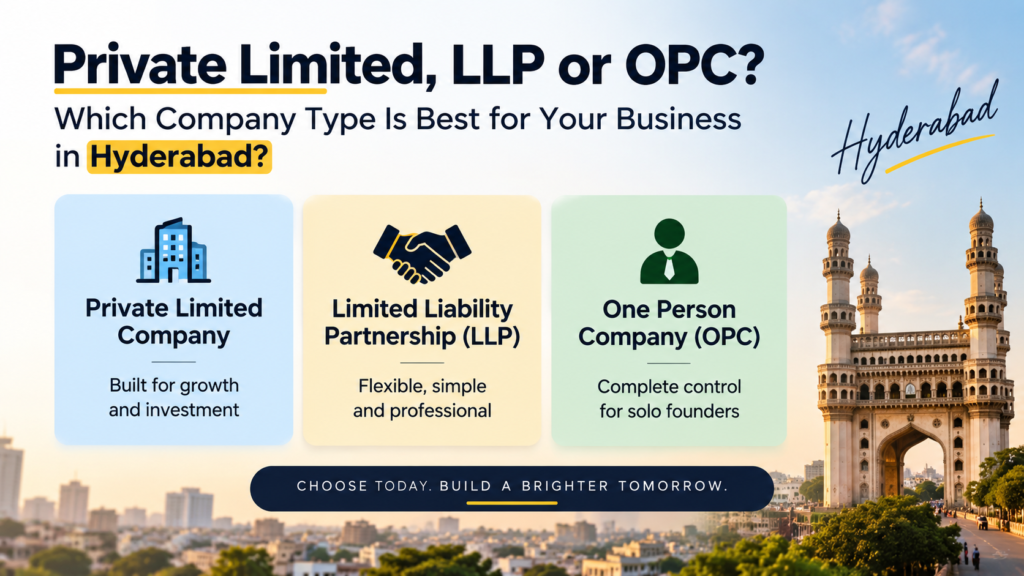
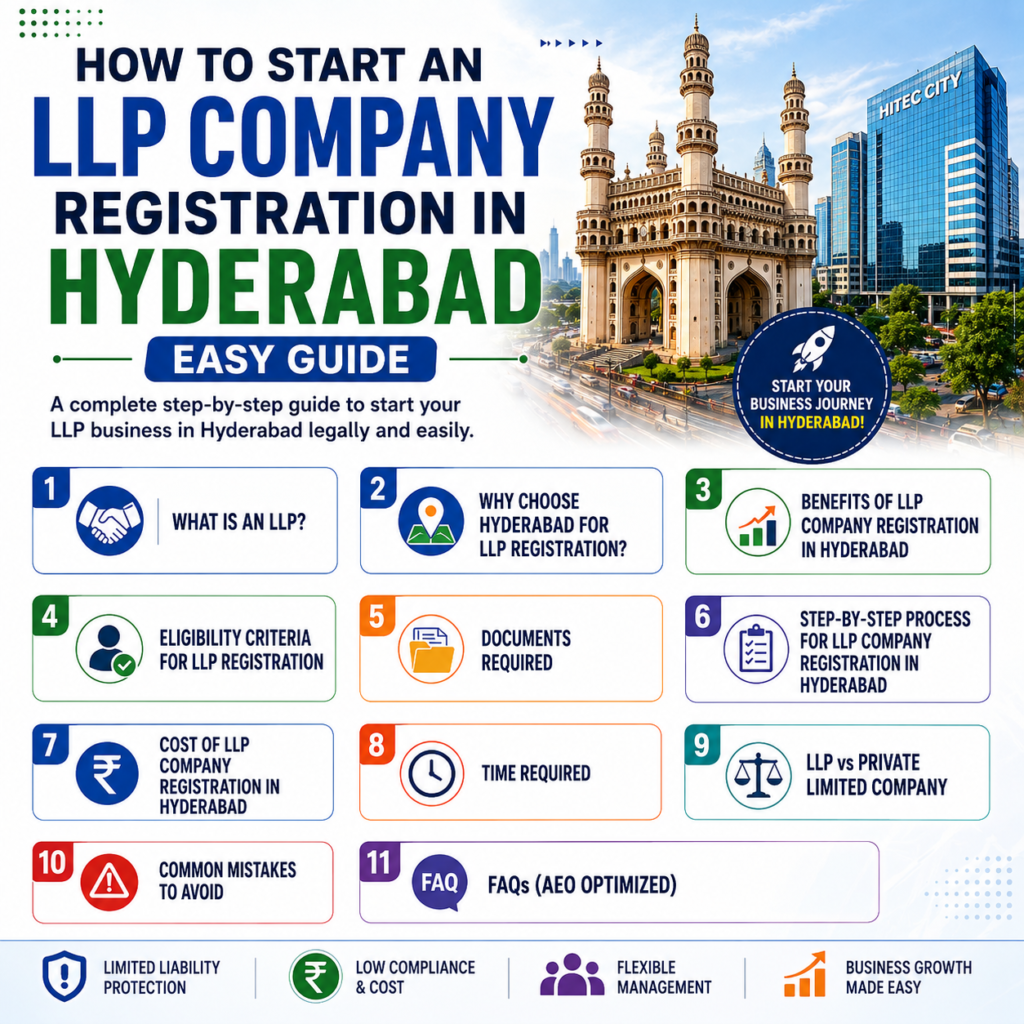
Limited Liability Partnership
A Limited Liability Partnership, or LLP, offers operational flexibility along with a separate legal identity and limited liability, subject to applicable laws and individual conduct.
It is commonly selected by consultants, professional service providers and businesses with multiple partners.
An LLP requires incorporation and ongoing filings with the Ministry of Corporate Affairs. Its compliance responsibilities are generally more structured than those of a traditional partnership firm.
One Person Company
A One Person Company allows a single promoter to establish a company with a separate legal identity.
It may be suitable for individual entrepreneurs who want a corporate structure and limited liability while maintaining control over the business.
An OPC must meet applicable incorporation, accounting and annual filing requirements.
Private Limited Company
A private limited company is commonly preferred by startups and growth-oriented businesses.
It provides:
- A separate legal identity
- Limited liability
- Defined shareholding
- Better ownership continuity
- Opportunities to introduce investors
- A structured governance framework
However, it also involves regular accounting, statutory records, annual filings and other corporate compliance requirements.
Company incorporation applications are handled through the Ministry of Corporate Affairs using its prescribed incorporation services and forms.
Step 2: Select and Approve the Business Name
The proposed business name should be unique, appropriate and relevant to the nature of the business.
For companies and LLPs, the name must follow the naming rules prescribed by the Ministry of Corporate Affairs. Entrepreneurs should avoid names that are identical or confusingly similar to existing registered entities or protected trademarks.
Before finalising a name, it is useful to check:
- Company or LLP name availability
- Trademark availability
- Domain-name availability
- Social-media username availability
- Relevance to the business activity
- Ease of pronunciation and recall
Choosing a distinctive name helps with registration, branding and future trademark protection.
Step 3: Prepare the Required Documents
The documents required depend on the selected structure and business activity.
Common documents may include:
- PAN of the proprietor, partners or directors
- Aadhaar or another identity document
- Passport-sized photographs
- Address proof of owners or directors
- Registered-office address proof
- Rental agreement or ownership document
- No-objection certificate from the property owner
- Utility bill for the business premises
- Partnership deed, where applicable
- Digital Signature Certificate
- Proposed business activities
- Capital and ownership details
All documents should contain consistent names, addresses and identification details. Differences between PAN, Aadhaar, bank records and address documents can delay registration.
Step 4: Obtain PAN and TAN
A Permanent Account Number is essential for tax identification and many business-related financial transactions.
Depending on the business structure, the organisation may receive or apply for its own PAN. A company, LLP or partnership firm generally uses the PAN issued in the entity’s name, while a sole proprietor commonly uses the individual proprietor’s PAN for income-tax purposes.
A Tax Deduction and Collection Account Number may be required when the business is responsible for deducting or collecting tax at source.
TAN must be quoted in applicable TDS or TCS returns, payments, certificates and prescribed communications.
Step 5: Complete GST Registration
Goods and Services Tax registration may be required depending on factors such as turnover, nature of supply, location of customers and specific activities covered by compulsory-registration provisions.
Businesses should not assume that GST registration depends only on turnover. Certain transactions or business models may trigger registration requirements even in other circumstances.
The GST registration process is completed through the official GST portal. Applicants use the registration section to provide details about the business, promoters, authorised signatories, place of business and bank account.
Once registered, the business may have to:
- Issue GST-compliant invoices
- Maintain purchase and sales records
- Determine the correct tax rate
- Collect GST where applicable
- Claim eligible input tax credit
- Reconcile accounting and portal data
- File applicable GST returns
- Pay tax within the prescribed timelines
- Maintain valid registration information
Businesses eligible for the Quarterly Return Monthly Payment scheme may file returns quarterly while making monthly tax payments, subject to applicable conditions. The official GST guidance states that the scheme applies to eligible taxpayers within the prescribed turnover limit.
Step 6: Register for Professional Tax in Telangana
Professional tax is governed at the state level. Businesses, employers and professionals operating in Hyderabad should assess whether professional tax registration or enrolment applies to them.
The Telangana Commercial Taxes Department provides online services for new professional tax registrations, payments and return filing.
The Telangana portal allows professionals, employers and business entities to register and manage their professional tax obligations online.
The portal also indicates that businesses already registered under GST or VAT may receive automatic professional tax registration, subject to the process and conditions stated by the department. Businesses should verify whether a PTIN has been generated instead of assuming that no further action is required.
Step 7: Check Local and Industry-Specific Registrations
Business incorporation alone may not be sufficient to begin operations.
Depending on the location, workforce and industry, a business may need additional registrations, licences or approvals.
These can include:
- Shops and establishments registration
- Municipal trade licence
- Food business licence
- Import Export Code
- Factory-related approvals
- Pollution-control permissions
- Fire and safety approvals
- Labour-law registrations
- Employees’ provident fund registration
- Employee state insurance registration
- Drug or healthcare licences
- Industry-specific permits
A restaurant, manufacturing unit, clinic, construction company and software consultancy do not have the same approval requirements.
Entrepreneurs should prepare a customised registration checklist based on their exact activities rather than following a generic list.
Understanding Income-Tax Compliance
Every business must evaluate its income-tax responsibilities according to its legal structure and taxable income.
Income-tax compliance may involve:
- Maintaining books of accounts
- Recording income and expenses
- Calculating taxable profit
- Paying advance tax where applicable
- Filing the correct income-tax return
- Completing a tax audit where required
- Reporting specified financial transactions
- Responding to tax notices
- Preserving supporting records
The Income Tax Department’s e-filing portal provides services for return filing, forms, payments, notices, verification and other tax-related processes.
The applicable return form and filing requirements differ for proprietorships, partnerships, LLPs and companies. Therefore, businesses should not use the same tax-filing approach for every entity type.
TDS Compliance for Businesses
Tax Deducted at Source may apply when a business makes certain payments covered by income-tax provisions.
These may include applicable payments for:
- Salaries
- Professional services
- Contract work
- Commission
- Rent
- Interest
- Technical services
Where TDS provisions apply, the business may need to:
- Deduct tax at the correct rate.
- Deposit it within the prescribed timeline.
- File the appropriate TDS return.
- Issue the required TDS certificate.
- Reconcile the amounts with accounting records.
- Quote the correct PAN and TAN details.
Incorrect deductions, delayed deposits and incomplete returns can result in interest, fees, disallowances or other consequences.
Accounting and Bookkeeping Requirements
Accurate accounting is the foundation of tax compliance.
Every business should systematically record:
- Sales
- Purchases
- Business expenses
- Receipts and payments
- Bank transactions
- Customer balances
- Vendor balances
- Employee costs
- GST input and output
- TDS deductions
- Loans and capital contributions
- Fixed assets
- Inventory
Maintaining proper books helps management understand profitability, cash flow, tax liabilities and outstanding payments.
It also makes GST filing, income-tax filing, audits and financial reporting more accurate.
Annual Compliance for Companies and LLPs
Companies and LLPs generally have ongoing compliance responsibilities in addition to tax return filing.
Depending on the entity and applicable provisions, these may include:
- Maintenance of statutory records
- Preparation of financial statements
- Statutory audit
- Annual returns
- Financial statement filings
- Director or partner-related filings
- Disclosure of specified interests
- Documentation of meetings and resolutions
- Income-tax returns
- GST and TDS compliance
Missing annual filings can result in additional fees, penalties and compliance issues for the entity and its responsible officers.
A compliance calendar helps management track every monthly, quarterly and annual requirement.
Common Business Compliance Mistakes
Businesses in Hyderabad should avoid the following common mistakes:
- Choosing an unsuitable business structure
- Starting operations without checking licence requirements
- Delaying GST registration
- Mixing personal and business transactions
- Ignoring professional tax obligations
- Missing GST, TDS or income-tax deadlines
- Claiming unsupported expenses
- Taking ineligible input tax credit
- Not reconciling GST returns with books
- Failing to maintain invoices and supporting documents
- Ignoring Ministry of Corporate Affairs filings
- Updating registrations late after an address or ownership change
- Waiting until year-end to complete bookkeeping
Regular monthly reviews can identify errors before they become serious compliance problems.
How a Chartered Accountant Helps
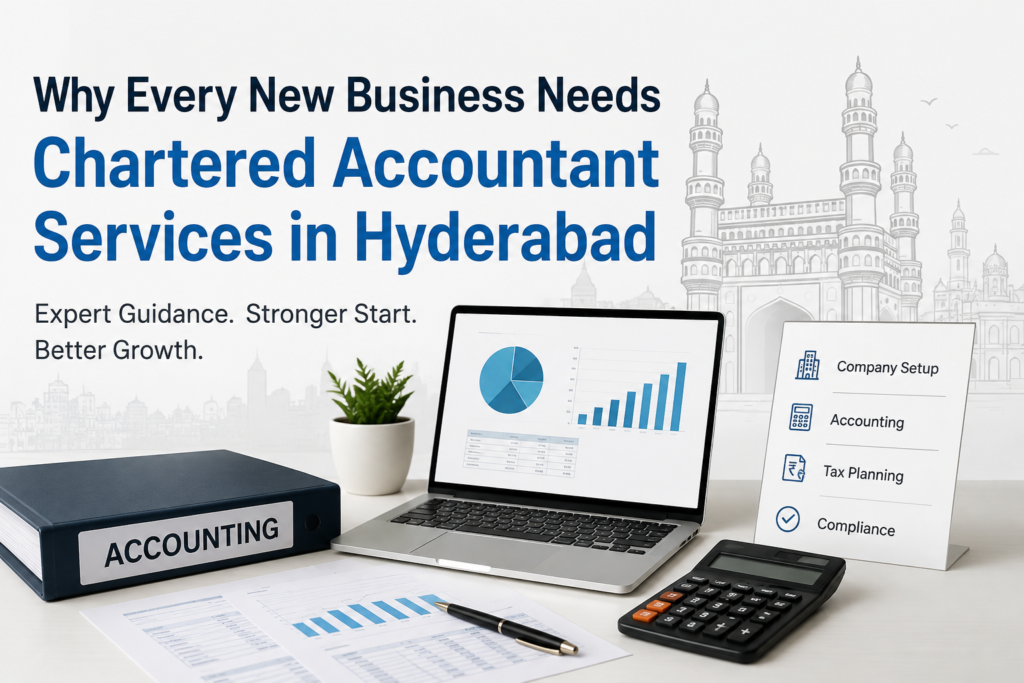
A Chartered Accountant supports businesses during registration and throughout their operational life.
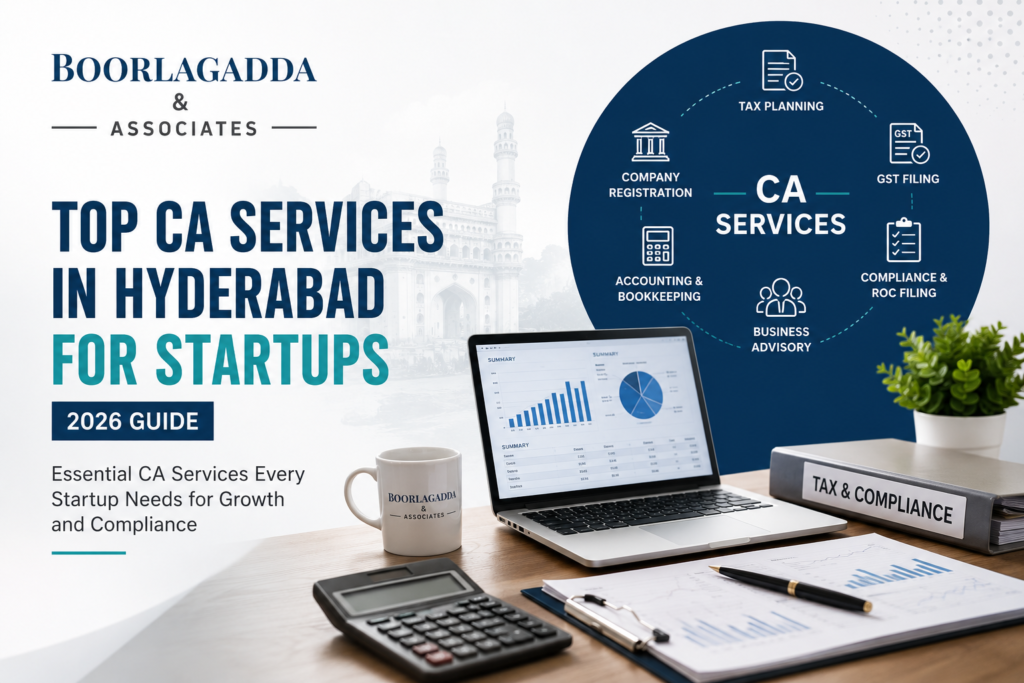
Professional Chartered Accountant services in Hyderabad may include:
- Selection of business structure
- Company and LLP incorporation assistance
- PAN and TAN support
- GST registration
- Professional tax registration
- Accounting and bookkeeping
- GST return filing
- TDS calculation and filing
- Income-tax planning
- Income-tax return filing
- Audit assistance
- Payroll compliance
- Financial statement preparation
- Corporate compliance coordination
- Representation before tax authorities
A CA also helps business owners understand how registration decisions affect taxation, liability, funding and future expansion.
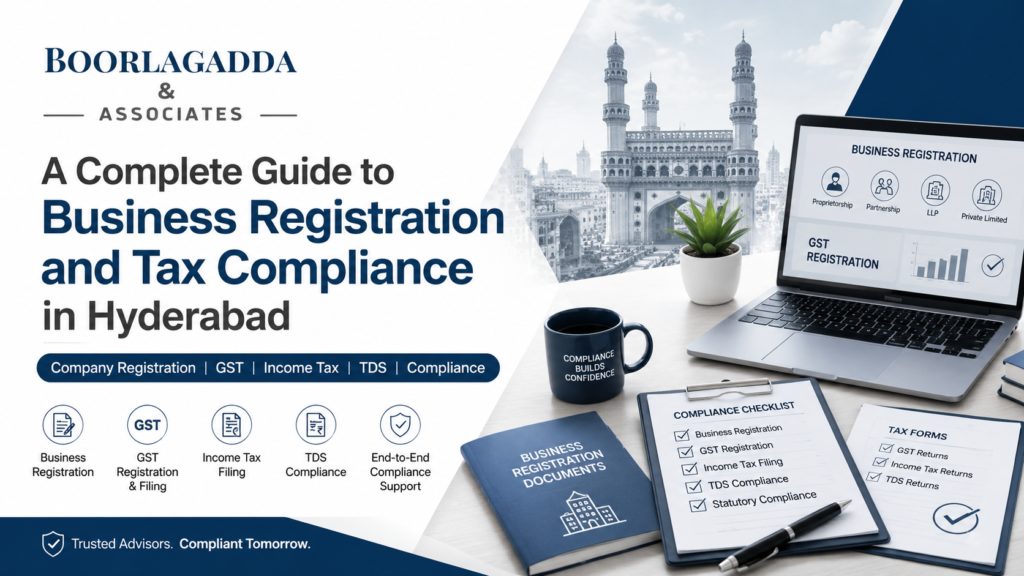
Business Registration and Tax Compliance Checklist
Before starting operations, verify the following:
- The appropriate business structure is selected.
- The business name is checked and approved.
- Incorporation or formation documents are completed.
- PAN and TAN are obtained where applicable.
- A current bank account is opened.
- GST applicability is evaluated.
- Professional tax obligations are verified.
- Local and industry licences are identified.
- An accounting system is established.
- Invoice formats meet applicable requirements.
- TDS applicability is reviewed.
- A monthly and annual compliance calendar is prepared.
- Personal and business transactions are separated.
- Important documents are securely maintained.
Conclusion
Business registration is only the beginning of an entrepreneur’s compliance journey. After establishing the entity, the business must regularly manage GST, income tax, TDS, professional tax, accounting and applicable corporate filings.
Proper business registration and tax compliance in Hyderabad protects the organisation from avoidable penalties, improves financial transparency and increases trust among customers, investors, banks and vendors.
Since every business has different activities, turnover, ownership and workforce requirements, there is no universal registration checklist. Professional guidance helps entrepreneurs select the correct structure, complete the necessary registrations and establish an effective compliance system.
By working with an experienced provider of Chartered Accountant services in Hyderabad, business owners can concentrate on operations and growth while ensuring that their financial and regulatory responsibilities are managed accurately.
Disclaimer: This article provides general information and does not constitute legal or tax advice. Registration requirements, limits, tax provisions and filing timelines may change. Businesses should consult a qualified Chartered Accountant or legal professional based on their specific circumstances.